

















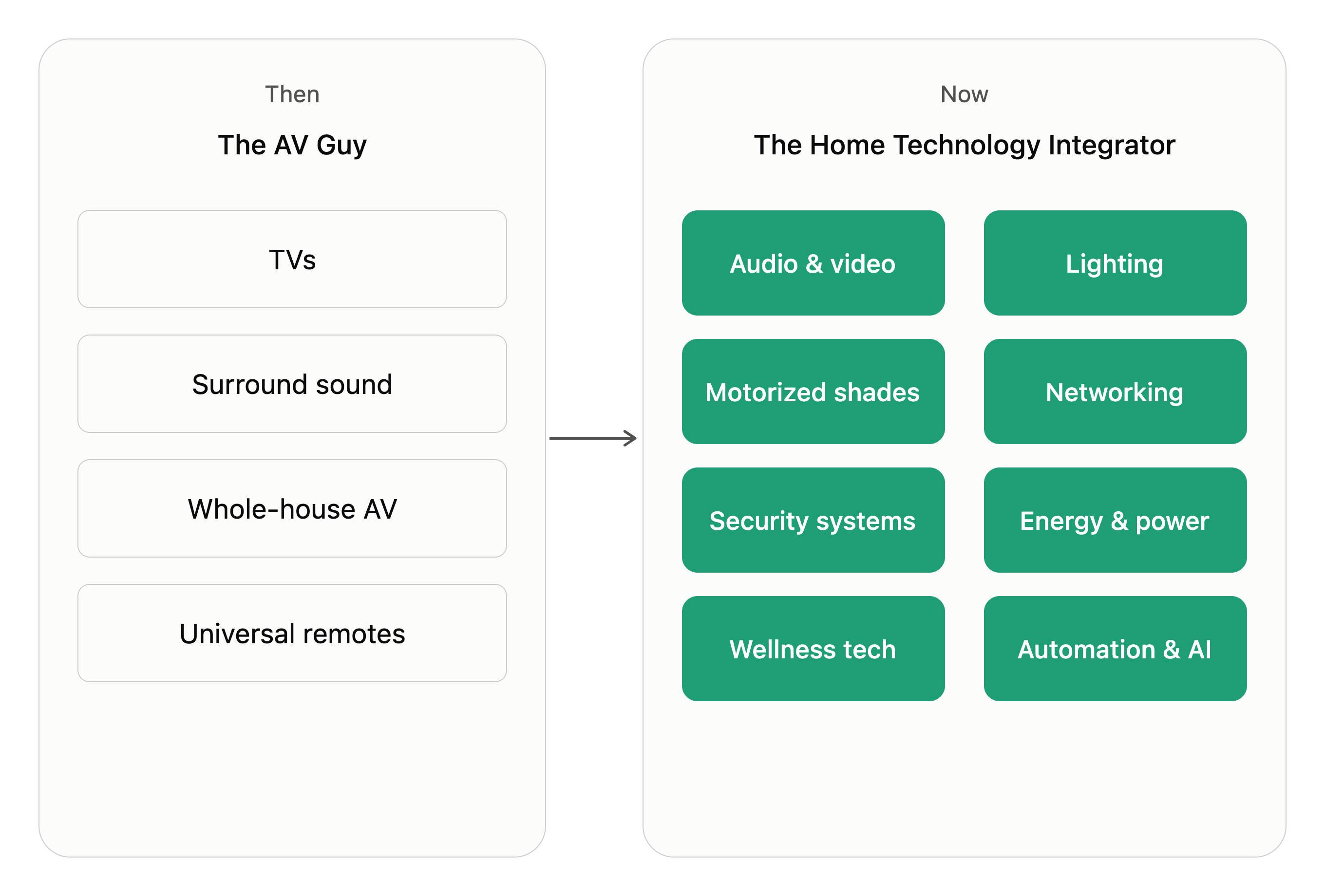
Calling someone the “AV guy” may sound harmless, but the label shapes how architects, interior designers, and builders understand the role and when they bring that professional into a project. If the job is perceived as installing televisions and speakers, the call comes after the plans are complete. If the role is understood as coordinating lighting, shading, networking, security, power, controls, and entertainment with the architecture and interiors, that professional becomes an essential design team member from the start.
That single shift from "call them once the walls are up" to "they need to be in the room during schematic design" captures something the industry's vocabulary hasn't caught up to.
For decades, residential technology professionals have been referred to as the "AV guy," the “AV installer”, the "low-voltage contractor," the “home theater company”, or the “home automation company.” Those descriptions made sense when home technology revolved primarily around televisions, distributed audio, home theaters, and structured wiring.
Today's luxury homes bear little resemblance to those projects, and the honest truth is that "AV guy" will probably stay part of the industry's vocabulary for years regardless of what we call the work. Habits change slowly. But that's exactly why we need to start defining the trade more precisely now, rather than waiting for the old habits to fade on their own.
Much More Than Audio and Video
Audio and video remain an important part of every integration firm's business, but they are no longer the whole story.
Today's integration firms routinely design and coordinate motorized shading, lighting control systems, architectural lighting fixtures, enterprise-grade networking, Wi-Fi, surveillance, access control, environmental sensing, outdoor entertainment, landscape lighting, power management, energy monitoring, and automation platforms that connect these systems into a unified experience.
A modern luxury home’s technology systems increasingly communicate with one another and respond together. A single scene may adjust lighting, lower shades, activate landscape lighting, change the home's climate settings, and prepare an entertainment space before the homeowner enters the room.
Coordinating that level of interaction requires integration. CEDIA's market research points in the same direction, showing networking, lighting control, shading, and security occupying a larger and still-growing share of the residential integration market alongside traditional audio and video.
Why the Name Matters
When it comes to what we call the home technology integrator, it’s all about setting expectations. When architects think "AV," they often think televisions, speakers, and home theaters. When builders hear "low-voltage contractor," they may think wiring and trim-out. This is a crucial distinction, because those assumptions influence when technology professionals are introduced to a project and what responsibilities they're expected to assume.
As we keep repeating in our LinkedIn series, the best integration firms are participating during schematic design, coordinating with architects, interior designers, builders, electricians, lighting designers, HVAC contractors, and landscape professionals. They help determine equipment locations, coordinate shade pockets, specify wiring pathways, review ceiling details, plan network infrastructure, coordinate power requirements, determine cooling requirements for tech equipment locations, and ensure technology systems can be integrated without compromise.
None of the nomenclature of yesterday’s home tech scene accurately captures that responsibility.
Long Live The ‘Technology Integrator’
The Home Technology Association uses the term Technology Integrator because it describes the profession's primary responsibility. Integration is the coordination of multiple independent systems into a single, reliable user experience. That responsibility extends well beyond product installation to include planning, documentation, infrastructure coordination, programming, commissioning, and long-term support, along with coordinating technology-related trades so builders aren't left managing every interaction between lighting, shading, networking, security, audiovisual, and control systems.
Yes, other terms have been floated, like “electronic systems contractor” "electronic systems contractor" or "smart home professional." Most of them either understate the coordination role, are too DIY in terms of connecting to off-the-shelf smart home products, or overstate the emphasis on any one system.
As homes become more sophisticated, this role increasingly resembles the coordination responsibilities associated with other building systems, which is why CEDIA has advocated for "Technology Integrator" to become an officially recognized occupation within the U.S. Standard Occupational Classification system, citing the profession's distinct combination of design, networking, systems integration, programming, and project coordination. The Home Technology Association aligns with CEDIA on this point and believes that the professional is best described as the Technology Integrator.
A Challenge for the Industry
This conversation isn't directed only at architects, designers, and builders. It's also directed at integration firms. Many companies continue to introduce themselves as audio/video specialists while simultaneously offering lighting control, motorized shading, networking, power management, wellness technologies, and sophisticated automation systems. We can’t expect project teams to think differently if it keeps describing itself the same way it did twenty years ago.
A trend we’ve seen, and champion, are home technology integrators changing their company names and dropping terms like “audio video” “home theater” “AV” and similar from their names. They realize their old company names unnecessarily limit their scope.
The services being delivered have evolved. The language should evolve with them. Leading with televisions and speakers no longer reflects the value many firms provide to residential projects. For many luxury homes, those systems represent only one portion of a much larger technology strategy.
So tell us in the comments, what do you advocate for and why? We want to hear your opinion.
You Might Also Like: