
















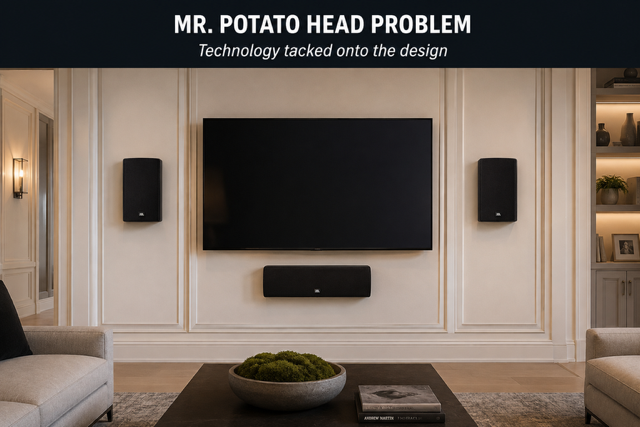
Two rooms. Same television. Two completely different design outcomes.
There’s a story that circulates among veteran integrators, one that traces back to Roy Glasner, co-founder of DSI Entertainment Systems in Los Angeles. Roy had a hilarious term for a look that shows up in far too many homes: a flat-screen television flanked by right and left on-wall speakers, with a center-channel speaker mounted underneath.
He called it “Mr. Potato Head.”
Anyone who has walked into a living room and immediately spotted three black boxes clustered around a television knows exactly what Roy meant. The eyes, the ears, the mustache, all stuck onto the same face. Functional, sure, but far from great design.
Now picture the alternative.
The television disappears behind a motorized panel or a piece of art until someone wants to watch it. The speakers are nowhere to be seen, built into the wall or ceiling with a finish that matches the surrounding surface. The room reads as a room first, and the technology appears only when asked to.
Same square footage. A completely different design result.

A Mistake That Can Be Avoided
Mr. Potato Head isn’t necessarily the result of a bad technology integrator.
More often, it happens when technology gets specified after the walls, framing, and finishes are already decided. A television and a soundbar, or a “Mr. Potato Head” speaker array, are added to a room that was never planned around them, so the technology sits on top of the architecture rather than becoming part of it.
Hiding that same equipment, whether behind a motorized lift, a piece of art, or an acoustically transparent surface, cannot be a last-minute decision. It requires multi-discipline planning; planning that a good technology integrator is happy to coordinate.
Blocking has to be in the wall before drywall goes up. Power and low-voltage wiring have to land in the right places. The cavity behind the art or panel has to be sized correctly for the lift mechanism and the equipment it conceals.
Once the wall is finished, solving those problems usually means opening it back up.
This is exactly the kind of decision the HTA Project Technology Assessment is designed to surface early. Hidden technology, including invisible speakers and motorized TV or panel lifts, is one of the categories it specifically prompts a homeowner or design team to consider before finishes are locked.
Of course, hidden speakers are not always the goal.
Though many homeowners and their design teams prefer to keep speakers invisible, others choose speakers designed to blend into the room. Custom wood grains, paint finishes, metal inlays, piano finishes, and other options can turn a loudspeaker into an intentional design element.
In highly designed interiors, visible speakers can be a deliberate aesthetic choice and sometimes one of the client’s favorite objects in the room.
The important point is that the choice should be intentional.
The Potato Head Resurfaces with LED Video Walls
The Benefits of Early Planning
A qualified technology integrator brought in during Schematic Design can lay out what a stealth installation requires well before electrical and framing bids are requested.
For a video display, that planning may include:
- Video display size and type
- Speaker type and locations, including conventional, invisible, or intentionally visible high-design options
- Concealment options, including doubling as a digital-art display, motorized reveals, and art lifts
- Electrical requirements
- Framing requirements, including structural support, blocking, and recessed cavity dimensions
- Cooling and ventilation requirements
- Room acoustics
These decisions are part of the broader space-planning conversation that should happen while the project is still on paper. We explored many of those considerations in Space Planning for Home Technology in Luxury Homes.
The technology doesn’t have to compete with the design. It can disappear into it.
A concealed solution typically costs more and requires more planning, but the aesthetic payoff can be enormous.
When the architecture, framing, power, audio, ventilation, and concealment strategy are coordinated early, the technology looks intentional. It becomes part of the design rather than something visibly added to a finished room as an afterthought.
Loop in a qualified integrator while the room design is still on paper.
That single conversation is often the difference between Mr. Potato Head and a clean, elegant entertainment environment.
Find an HTA Certified integrator to plan hidden technology into your next project at htacertified.org.
You Might Also Like: